
Canadians eat roughly 26,000 tonnes of fresh garlic a year. Canadian farms grow about 1,900 tonnes of it.
That gap is the whole story of garlic in this country. In 2023, Canada imported 24,188 tonnes of fresh garlic, and roughly 80% of that volume came from a single source: China. Meanwhile, domestic growers marketed 1,918 tonnes for $22.9 million in farm gate receipts — a record, and still barely a rounding error against demand.
If you grow garlic in Canada, you are not competing for market share. You are competing for the ability to supply it.
The numbers are moving in your favour
Statistics Canada put Canadian garlic plantings at a record 950 hectares in 2023 — about 2,350 acres nationally. Farm gate value has more than doubled over the previous decade, from $11.1 million to $22.9 million. Ontario leads at $9.9 million, followed by Quebec at $8 million and British Columbia at $3.5 million.
Ontario's turnaround shows how fast this can move. The province went from roughly 300 acres in 2014 to 750 acres by 2016 — a 150% jump in two years — after decades of contraction driven by cheap imports. Buyers wanted local, and growers who could deliver volume got the contracts.
The catch is in that last phrase. Most Canadian garlic operations are still under an acre, selling at farmers' markets and farm gate. That's a viable business, but it isn't the business that fills a grocery chain's order. Dan Hemstock, a long-time voice in the Ontario industry, has put the requirement plainly: growers who want to compete need "mechanization of equipment to increase efficiency" and value-added products.
Garlic is one of the few crops where that advice is genuinely actionable at a small-farm price point, because the crop has exactly two labour walls — and both of them have equipment answers.
Wall one: planting
Garlic is planted clove by clove, pointy end up, 2–3 inches deep. By hand, on your knees, a good crew plants maybe a third of an acre in a long day. That single constraint is why so many Canadian garlic farms are the size they are — not soil, not market, not climate. Just the number of cloves a human being can set in the ground before the frost line arrives.
It also compresses into a narrow window. Garlic needs four to six weeks of root development before freeze-up, which puts most of the country on a two-to-four week runway:
| Region | Planting window |
|---|---|
| Prairies (Winnipeg, Calgary) | Sept 20 – Oct 10 |
| Prairies (Edmonton) | Sept 25 – Oct 15 |
| Eastern Ontario / Quebec | Oct 1 – Oct 25 |
| Southern Ontario | Oct 10 – Nov 1 |
| Southwestern Ontario | Oct 15 – Nov 5 |
| BC Interior | Oct 1 – Oct 20 |
| Coastal BC & Vancouver Island | Oct 15 – Nov 20 |
Miss it and you don't get a smaller crop — you get a worse one, with weaker root establishment heading into a Canadian winter.
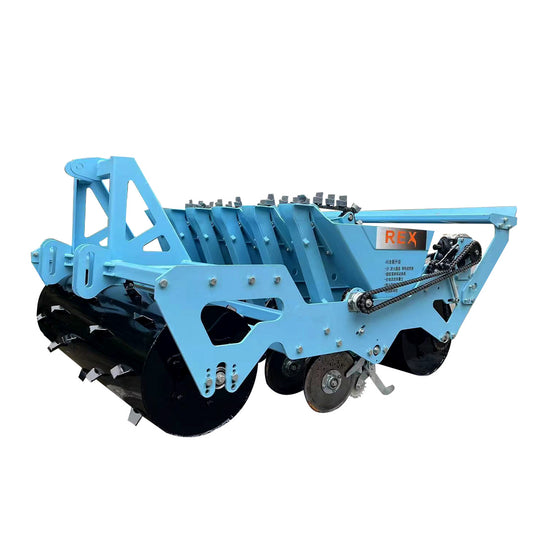
A tractor-mounted planter changes the arithmetic. The 3PT Garlic Planter 6 Rows (GP6) runs six rows on 20 cm spacing off a standard three-point hitch, with 0–5 cm depth adjustment and a dual gearbox drive. It ships with two trenching systems: a disc trencher pre-installed for sandy and mixed ground, and a plough trencher for dry soil. An extended operator stool lets a seated crew member feed and monitor rows on the move.
What it really buys you is the ability to plant the acreage you actually want to plant, inside the window your region gives you.
Wall two: post-harvest
The second wall shows up in July and August, and it catches growers off guard because the crop is already out of the ground and it feels like the hard part is over.
It isn't. Every bulb needs its roots and top tails removed before it can be cured, graded, and sold — and buyers judge you on that trim. Sloppy root cutting is the most common reason otherwise-good Canadian garlic gets bounced from retail-grade pricing down to bulk. Done by hand with snips, it's slow, it's repetitive, and it's the job nobody on the crew volunteers for.
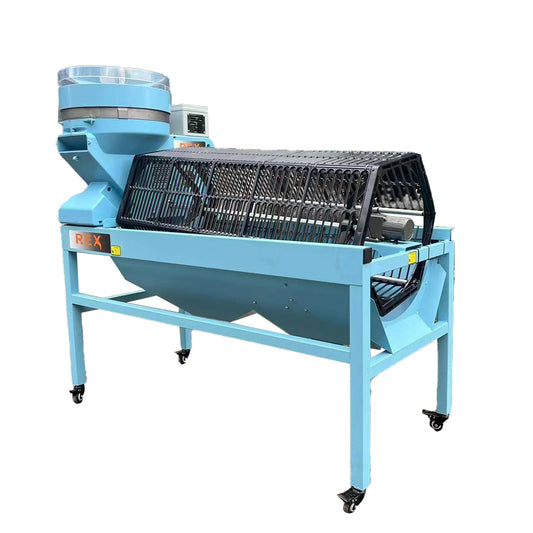
The Garlic Roots Cutter 48V (GRC48) is a dual-blade stainless steel unit that takes both the root plate and the top tail in one pass. It's dual-sided for continuous operation, runs off 48V DC (four 12V or two 24V batteries in series, sold separately), and weighs 12.5 lbs at 16" × 10.5" × 8.5" — small enough to sit on a packing bench or move out to a field station. It handles a 3.6" cutting area and works best on cloves 2" and up.
That 2" figure is worth noting for a different reason: it's roughly the threshold where seed stock earns its keep. Which brings us to the part of garlic farming that no machine solves.
Seed stock is the compounding decision
Garlic doesn't come from seed catalogues in any meaningful commercial sense. It comes from last year's crop. Every fall you decide what fraction of your harvest goes back in the ground instead of out the door, and that decision compounds for years.
Save your largest bulbs, break them late — as close to planting as you can, since cloves start losing viability once separated — and plant only the outer cloves. The small inner cloves are perfectly good eating and they will produce disappointing bulbs. Hardneck varieties, particularly the porcelain types like Music, dominate Canadian production for the obvious reason: they need the winter vernalization our climate hands them for free, and they scape, which gives you a saleable product in June before the bulbs are ready.
Budget roughly 10–15% of your harvest back to seed if you're holding steady, more if you're scaling. Growers who expand fast on purchased seed usually pay for it twice — once at the invoice, and again in disease pressure they didn't inherit from their own clean ground.
Then mulch it and walk away
Get 4–6 inches of straw on immediately after planting. On the Prairies, treat the full 6 inches as non-negotiable — the risk isn't cold, it's freeze-thaw cycling heaving cloves up out of the soil over the course of a long winter. Then the crop mostly looks after itself until scaping season.
That's the quiet appeal of garlic as a commercial crop in this country. The work is heavily front-loaded into two short, brutal windows. Solve those two windows and the acreage ceiling moves a long way up.
On sale until September 13
Both machines are discounted through September 13, 2026 — timed ahead of the Prairie and Ontario planting windows:
- 3PT Garlic Planter 6 Rows – GP6 — ~~$4,849.99~~ $4,364.99 CAD (save $485.00)
- Garlic Roots Cutter 48V – GRC48 — ~~$549.99~~ $494.99 CAD (save $55.00)
Questions about fit for your tractor or your operation? Call us at 1-877-453-3964 — we'd rather talk it through than have you order the wrong thing.
Sources: StatCan — Garlic production and sales dip, World Bank WITS — Canada garlic imports 2023, Small Farm Canada — Ontario garlic acreage up, GrowersGuide.ca — When to plant garlic in Canada